
Children learn to move, communicate, play and solve problems at different rates. A small difference in timing does not automatically mean something is wrong. However, when a child consistently has difficulty gaining age-expected skills, a developmental assessment can help explain what is happening and what support may be useful.
Understanding the different areas of development makes it easier for parents to describe concerns without jumping to conclusions.
Development is made up of several connected skills
Development is not a single ability. It includes physical movement, hand coordination, speech and communication, thinking and learning, and social-emotional interaction. A child may progress steadily in one area while needing extra support in another.
Some children have delays in more than one area. When delays affect several or all developmental domains, clinicians may use the term global developmental delay, depending on the child’s age and assessment findings.
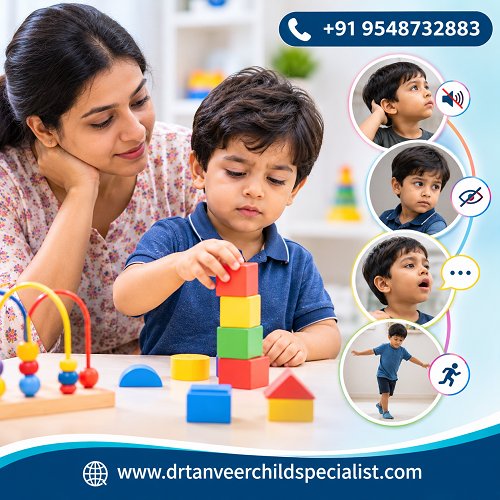
The main areas clinicians look at
Gross and fine motor development
Gross motor skills involve larger movements such as sitting, crawling, standing, walking, running and climbing. Fine motor skills use smaller muscles for actions such as grasping, picking up small objects, turning pages, drawing or using a spoon.
Differences may relate to muscle tone, coordination, strength, neurological conditions or other factors. An assessment considers the child’s overall movement rather than one isolated milestone.
Speech, language and communication
Communication includes understanding words, responding to sounds, using gestures, making sounds and speaking. A child may understand more than they can say, or may have difficulty both understanding and expressing language. Hearing problems can affect speech and language development, so hearing assessment may be part of the evaluation when indicated.
Cognitive and learning skills
Cognitive development includes attention, memory, problem-solving, curiosity and learning from experience. Difficulties may become more noticeable when children face new tasks at home or school.
A clinician considers the child’s opportunities to learn, health history, hearing and vision, and performance across different settings.
Social, emotional and adaptive skills
These skills include sharing attention, responding to familiar people, playing with others, expressing feelings and gradually managing everyday tasks. Children vary in temperament, and shyness alone does not establish a developmental delay. What matters is the broader pattern of interaction, communication and daily functioning.
Why a delay may occur?
There is no single cause. Development can be influenced by genetic or chromosomal conditions, prematurity, hearing or vision impairment, neurological conditions, complications around birth, chronic illness and environmental factors.
In many children, a clear cause is not identified at the first assessment. A delay is a description of a developmental pattern, not a complete diagnosis.
What happens during an assessment?
A paediatrician usually asks about pregnancy and birth history, medical conditions, feeding, sleep, family history and the skills the child has gained over time.
Parents may be asked what the child does during play, how they communicate, how they respond to familiar people and whether any previously acquired skill has been lost. Developmental screening tools can help identify children who need a more detailed evaluation. Screening is not the same as diagnosis.
Depending on the findings, the child may need hearing or vision checks, a developmental evaluation or referral to relevant specialists and therapy services.
The assessment plan should be based on the child’s needs rather than a fixed package of tests.
Why early support important?
Early assessment can identify practical ways to support a child’s communication, movement, learning and participation. Depending on the concern, support may involve speech and language therapy, occupational therapy, physiotherapy, hearing care, educational support or specialist medical input.
Families can also learn how to build useful activities into daily routines. Support does not need to wait until every diagnostic question has been answered.
At home, follow the child’s interests. Talk during everyday tasks, share picture books, sing, play turn-taking games and give the child time to respond.
Choose activities that are safe and suitable for the child’s current abilities. Avoid comparing siblings or using online milestone charts as a diagnosis.
When parents should raise a concern?
Speak with a healthcare professional if a child is not gaining skills expected for their age, has persistent difficulty in one or more developmental areas, or struggles to participate in everyday activities.
Losing a skill that the child previously used is especially important and should be assessed promptly. Bring examples, short videos where appropriate and a list of questions to the appointment.
Dr. Tanveer Ahmad provides pediatric consultations in Roorkee. Parents can explore the clinic’s information about child growth milestones, child development services and parent counselling for development-related concerns. A timely conversation can help families understand whether monitoring, screening or further assessment is the right next step.
Developmental progress is best understood over time. A child may show a new skill at home before using it in a group setting, or may need extra practice in an unfamiliar environment. Share these differences with the clinician rather than presenting only the most difficult moments.
Families can ask what progress to look for, when to review again and how to coordinate recommendations across home, preschool and therapy settings.
For related information, read parent counselling.
Parents should also tell the clinician about the child’s strengths and interests. A child who enjoys music, puzzles, movement or picture books may respond well when these interests are used during play and learning.
A balanced picture helps the care team understand both the areas that need support and the activities that already engage the child.
For additional clinic information, see baby and child health checkups.