
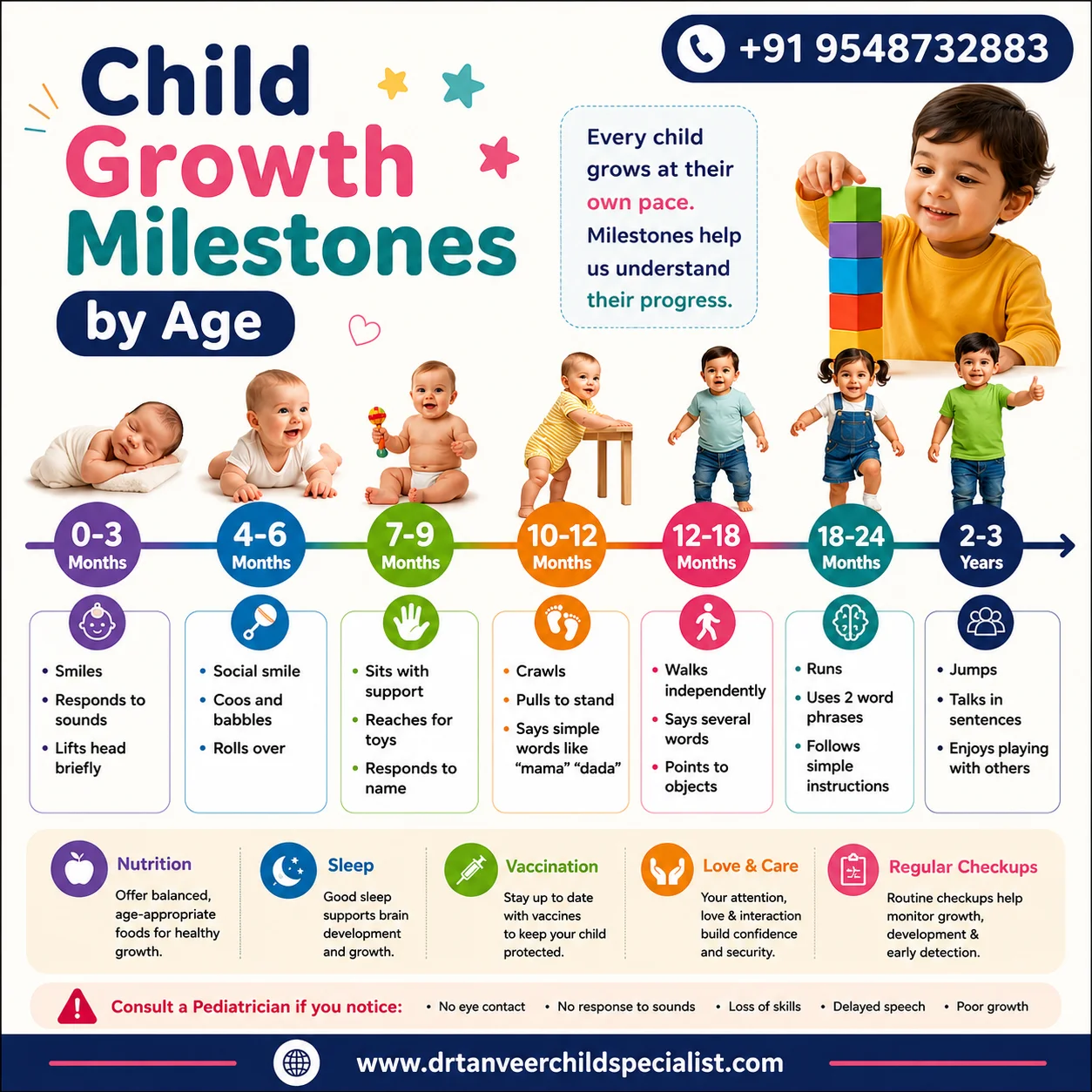
Every child grows at a different pace. Small differences in timing are normal. However, knowing the expected Child Growth Milestones by Age helps parents understand if their child is developing well. These milestones include physical growth, movement, communication, social interaction, and learning skills.
Regular monitoring helps identify concerns early. Early support often improves outcomes. Routine pediatric visits also help ensure that your child’s growth remains on track.
If your baby needs regular growth assessment, baby health checkups can help monitor physical growth and developmental progress.
Child Growth vs Child Development
Many parents use these terms interchangeably. They are related but different.
Child growth refers to physical changes such as:
- Height
- Weight
- Head circumference
- Body size
Child development refers to how a child learns new skills.
- Rolling over
- Sitting
- Walking
- Speaking
- Playing
- Problem-solving
Both growth and development should be monitored together because they provide a complete picture of your child’s health.
Understanding Child Growth Milestones by Age
Child Growth Milestones by Age are age-specific skills that most children achieve within a certain time range. They are not strict deadlines. Some children may reach milestones a little earlier or later.
Pediatricians usually observe four major areas during every developmental assessment.
- Gross motor skills
- Fine motor skills
- Language and communication
- Social and cognitive development
Monitoring these areas during routine visits helps identify developmental delays early.
Developmental Areas Parents Should Watch
Physical and Motor Skills
This includes head control, rolling, sitting, crawling, standing, and walking.
Language Skills
Babies begin with cooing. They later babble, respond to sounds, recognize familiar voices, and eventually say meaningful words.
Social and Emotional Skills
These include smiling, making eye contact, recognizing parents, waving goodbye, and responding to familiar people.
Cognitive Skills
Cognitive development includes memory, curiosity, learning through play, object recognition, and simple problem-solving.
Child Growth Milestones by Age: Birth to 3 Months
Physical Growth
- Steady weight gain
- Gradual increase in length
- Head circumference grows rapidly
Motor Skills
- Lifts head briefly during tummy time
- Moves both arms and legs actively
- Hands remain mostly closed
Language Development
- Crying communicates different needs
- Begins cooing around two months
- Turns toward familiar voices
Social Development
- Looks at faces
- Smiles socially
- Makes eye contact
Nutrition Tips
Exclusive breastfeeding is recommended during the first six months whenever possible. Formula feeding may be advised when medically appropriate. Parents should discuss feeding concerns with their pediatrician.
Parents of newborns can also learn more about newborn and neonatal care for healthy early development.
When to Speak to a Pediatrician
- No social smile by three months
- Does not respond to loud sounds
- Poor feeding
- Very stiff or very floppy body
Child Growth Milestones by Age: 4 to 6 Months
Physical Growth
- Steady weight gain continues
- Improved muscle strength
- Better head control
Motor Skills
- Rolls from tummy to back
- Pushes up during tummy time
- Reaches for nearby toys
- Transfers objects between hands
Language Development
- Laughs aloud
- Babbles repeatedly
- Responds to familiar voices
Social Development
- Enjoys interactive play
- Recognizes parents easily
- Shows excitement during playtime
Nutrition Tips
Breastfeeding or formula feeding should continue. Around six months, many babies are ready to begin complementary foods after medical advice. Iron-rich foods are usually introduced first.
Parents can read more about infant and child nutrition to support healthy growth.
Developmental Warning Signs
- Cannot hold head steady
- Does not reach for objects
- No babbling
- Shows very little interaction
Child Growth Milestones by Age: 7 to 9 Months
Physical Growth
- Continues gaining height and weight
- Improved balance and muscle coordination
Motor Skills
- Sits without support
- Starts crawling in different ways
- Begins pulling up with support
- Develops early pincer grasp
Language Development
- Responds to own name
- Babbles using repeated sounds
- Understands simple words like “no”
Social Development
- Enjoys peek-a-boo
- Shows stranger anxiety
- Looks for hidden objects
Activities for Parents
- Encourage floor play
- Read picture books
- Talk during daily routines
- Offer safe sensory toys
Consult Your Pediatrician If
- Baby cannot sit independently
- No response to own name
- Shows no interest in interaction
- Does not reach for objects
Child Growth Milestones by Age: 10 to 12 Months
Physical Growth
- Continued height gain
- Improved muscle strength
- Better balance
Motor Skills
- Pulls to stand
- Cruises along furniture
- May take first independent steps
Language Development
- Says simple words with meaning
- Points to objects
- Follows simple instructions
Social Development
- Waves goodbye
- Claps hands
- Imitates familiar actions
- Shows favorite toys to parents
Nutrition Tips
Most babies gradually begin eating a wider variety of family foods. Meals should remain balanced and age appropriate. Parents should continue offering iron-rich foods, fruits, vegetables, grains, and protein sources.
Sleep Needs During the First Year
| Age | Average Daily Sleep |
|---|---|
| 0–3 Months | 14–17 Hours |
| 4–6 Months | 12–16 Hours |
| 7–12 Months | 12–15 Hours |
Good sleep supports healthy brain development, learning, immunity, and physical growth.
Routine Vaccination Supports Healthy Development
Vaccines protect children from many serious diseases during early childhood. Following the recommended immunization schedule also supports healthy development by reducing the risk of preventable infections.
Parents can review the complete vaccination schedule for babies in India or learn more about child immunization services.
Medical Review and Child Development Care
This article is medically reviewed for educational purposes using current pediatric developmental guidance.
Dr. Tanveer Ahmad is an experienced Pediatrician practicing in Roorkee since 2018 at Dr Hera Skin Hair & Children Hospital. He provides newborn care, vaccination, routine health checkups, growth monitoring, nutrition counseling, developmental assessment, treatment of childhood illnesses, allergies, digestive disorders, and preventive child healthcare. His approach focuses on early diagnosis and personalized care to support healthy growth from birth through adolescence.
Learn more about Dr. Tanveer Ahmad or explore the available pediatric services.
Child Growth Milestones by Age: 12 to 18 Months
The second year brings rapid physical and mental development. During this stage, children become more independent. They also learn by exploring their surroundings.
Physical Growth
- Steady increase in height and weight.
- Improved balance and coordination.
- Stronger muscles for climbing and walking.
Motor Skills
- Walks without support.
- Climbs onto low furniture.
- Starts running with an unsteady gait.
- Stacks two or three blocks.
Language Development
- Says a few meaningful words.
- Points to familiar objects.
- Understands simple instructions.
- Attempts to repeat new words.
Social and Cognitive Development
- Enjoys pretend play.
- Shows affection toward family members.
- Copies everyday activities.
- Recognizes familiar people.
Nutrition Tips
Offer balanced meals with vegetables, fruits, cereals, pulses, dairy products, and protein-rich foods. Encourage self-feeding whenever possible.
Child Growth Milestones by Age: 18 to 24 Months
Physical Growth
- Steady physical growth continues.
- Improved body coordination.
- Better control during walking and running.
Motor Skills
- Runs more confidently.
- Kicks a ball.
- Walks upstairs with support.
- Turns book pages.
Language Development
- Vocabulary grows quickly.
- Uses two-word phrases.
- Names familiar people.
- Follows two-step instructions.
Social Development
- Shows curiosity.
- Begins parallel play.
- Enjoys simple pretend games.
- Recognizes body parts.
Activities That Support Development
- Read storybooks every day.
- Encourage simple puzzles.
- Sing rhymes together.
- Allow outdoor play.
Child Growth Milestones by Age: 2 to 3 Years
Physical Growth
- Continued height gain.
- Better muscle strength.
- Improved coordination.
Motor Skills
- Jumps with both feet.
- Climbs playground equipment.
- Draws simple shapes.
- Uses a spoon and fork independently.
Language Development
- Uses short sentences.
- Asks simple questions.
- Names common objects.
- Speech becomes easier to understand.
Social and Cognitive Development
- Enjoys playing with other children.
- Understands simple routines.
- Sorts objects by color or shape.
- Shows imagination during play.
Simple Activities to Support Healthy Development
Children learn best through daily interaction. Parents do not need expensive toys. Simple activities can strengthen learning and communication.
- Talk to your child throughout the day.
- Read books together.
- Limit unnecessary screen time.
- Encourage outdoor play.
- Offer age-appropriate toys.
- Allow supervised exploration.
- Praise new achievements.
Parents looking for personalized guidance can also benefit from parent counselling for child nutrition, behavior, and development.
Common Myths About Child Growth Milestones
Myth: Every child reaches milestones at the same age.
Fact: Development happens within a normal age range. Small differences are expected.
Myth: Boys always speak much later than girls.
Fact: Every child develops differently. Persistent speech delay should always be assessed.
Myth: Skipping crawling always indicates a problem.
Fact: Some healthy children move directly to walking. Overall development is more important than a single milestone.
Warning Signs That Need Medical Attention
Parents should seek medical advice if they notice any of the following.
- Loss of previously learned skills.
- No meaningful words by around one year.
- Not walking independently by 18 months.
- Poor eye contact.
- No response to sounds.
- Persistent feeding difficulties.
- Limited social interaction.
Children with developmental concerns may benefit from an evaluation at a child development clinic.
How Parents Can Track Child Growth Milestones by Age
Keeping simple records helps identify changes over time.
- Measure height and weight regularly.
- Record new skills every month.
- Attend routine pediatric visits.
- Follow the recommended vaccination schedule.
- Discuss concerns early instead of waiting.
If your child is growing slowly or has poor weight gain, read more about possible causes of poor weight gain in children.
Frequently Asked Questions
Is it normal if my baby walks after the first birthday?
Yes. Many healthy children begin walking anytime between 9 and 18 months. Your pediatrician can assess whether development remains within the expected range.
Can nutrition affect child development?
Yes. Balanced nutrition supports healthy brain development, physical growth, immunity, and learning.
Should I compare my child with other children?
No. Children reach milestones at different times. Regular developmental assessments provide a better understanding than comparison with others.
When should I consult a pediatrician?
Consult your pediatrician if you notice developmental regression, delayed milestones, poor growth, feeding difficulties, or any behavior that concerns you.
Expert Pediatric Care in Roorkee
Dr. Tanveer Ahmad has been practicing as a Pediatrician in Roorkee since 2018 at Dr Hera Skin Hair & Children Hospital, Malviya Chowk, Near Bank of India, Roorkee, Uttarakhand – 247667.
https://maps.app.goo.gl/QbuntejF7L7agaoP7
The clinic provides newborn care, vaccination, growth and development monitoring, nutrition counseling, treatment of childhood illnesses, preventive healthcare, allergies, digestive disorders, and routine pediatric consultations. Every child receives an individualized assessment based on age, medical history, growth pattern, and developmental progress.
For appointments or pediatric consultation, visit the contact page or explore the official website at Dr. Tanveer Child Specialist.
Conclusion
Understanding Child Growth Milestones by Age helps parents support healthy development from infancy through early childhood. Every milestone represents progress, not a race.
Regular health checkups, balanced nutrition, timely vaccination, active play, and responsive parenting all contribute to healthy growth.
If you ever notice delayed development or loss of previously learned skills, seek medical advice without delay.
Early evaluation and appropriate guidance can make a meaningful difference in your child’s long-term health and development.