
It is common for parents to notice small challenges in their toddler’s daily activities. A child may struggle to hold a crayon, pick up small objects, or use a spoon properly. These early difficulties are often linked to fine motor development.
The good part is that these skills can improve with the right approach. Simple and consistent practice can help toddlers gain better control over their hands and fingers.
This guide focuses on practical fine motor skills activities for toddlers. Each activity is easy to follow and can be done at home using simple materials.
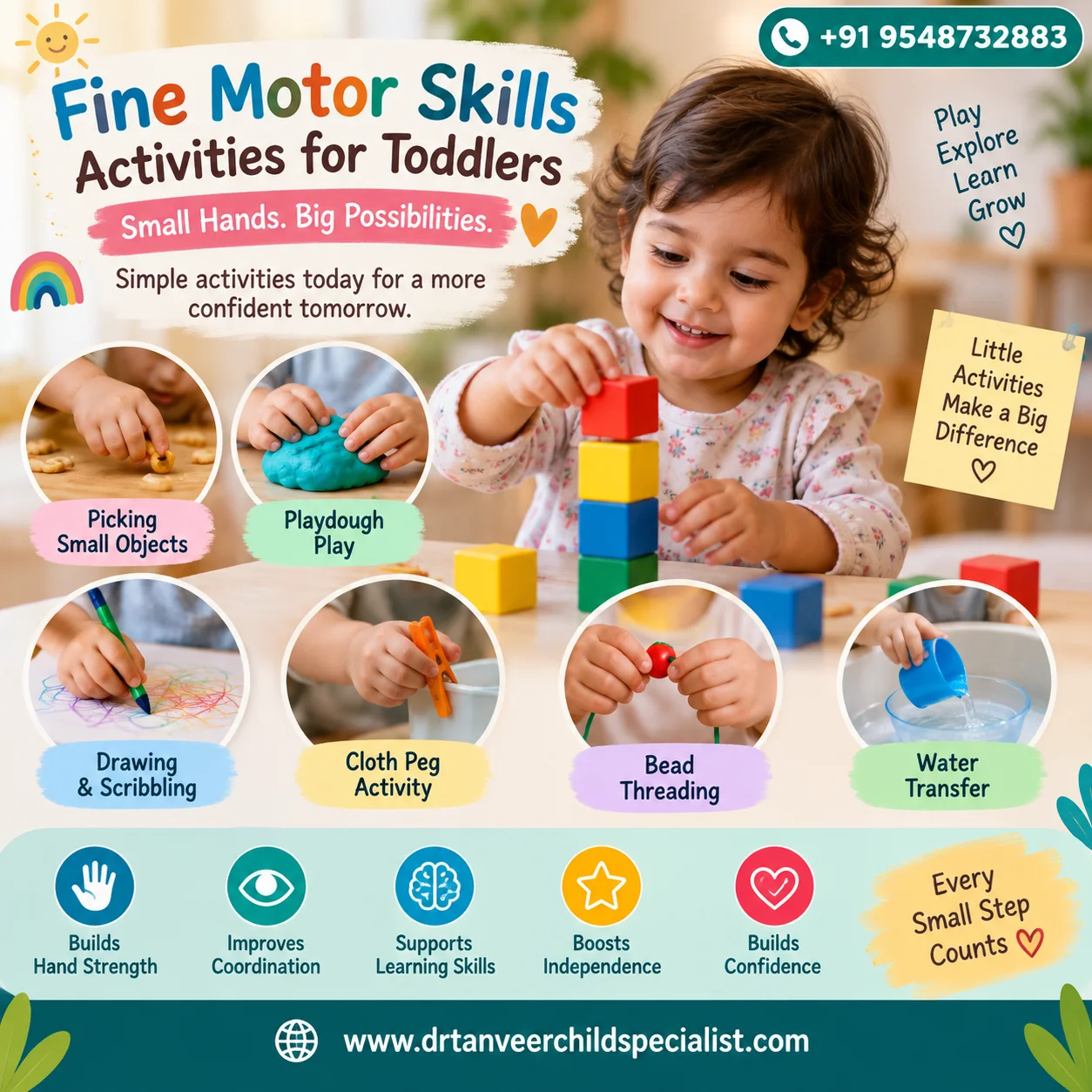
What Are Fine Motor Skills?
Fine motor skills refer to the use of small muscles in the hands and fingers. These skills allow a child to grasp, hold, and manipulate objects.
They are closely connected with hand-eye coordination. This means the eyes guide the hands to perform specific actions.
These skills are essential for everyday tasks such as eating, drawing, turning pages, and eventually writing.
Fine Motor Skills in Early Years
The early years are a critical phase for growth. During this time, the brain and body develop rapidly. Activities that involve hand movement help strengthen neural connections.
Fine motor skills activities for toddlers support:
Better grip and finger control
Improved coordination
Increased independence in daily tasks
Confidence in learning new skills
Along with activities, proper nutrition supports muscle and brain development. You can explore useful guidance on infant and child nutrition.
Fine Motor Development: What to Expect in Toddlers
Each child develops at their own pace. Still, certain patterns are commonly observed during the toddler stage.
Between 1 to 2 years, children begin to explore objects actively. They try to hold, drop, and move things around.
Between 2 to 3 years, control improves. Children start performing more structured actions like stacking, drawing, and using tools.
Tracking progress helps in early identification of delays. You can review child growth milestones by age for better understanding.
Fine Motor Skills Activities for Toddlers (1–2 Years)
At this stage, activities should be simple. The focus should be on exploration and repetition.
Stacking Blocks
How to do: Provide soft blocks. Show how to place one over another.
Skills developed: Hand coordination and control.
Tip: Start with fewer blocks. Increase gradually.
Placing Objects in Containers
How to do: Give a bowl and small toys. Ask your child to place them inside.
Skills developed: Grip and focus.
Tip: Use different shapes to maintain interest.
Crayon Scribbling
How to do: Offer thick crayons. Allow free drawing.
Skills developed: Finger strength and early writing control.
Tip: Avoid forcing structured drawing.
Picking Finger Foods
How to do: Provide small, soft food pieces.
Skills developed: Pincer grasp.
Tip: Always supervise during eating activities.
Fine Motor Skills Activities for Toddlers (2–3 Years)
At this stage, toddlers begin to show better control. Activities can involve more coordination.
Playdough Play
How to do: Give soft dough. Encourage pressing, rolling, and shaping.
Skills developed: Finger strength and creativity.
Tip: Add simple tools for variety.
Large Bead Threading
How to do: Use large beads with a thick string.
Skills developed: Hand-eye coordination.
Tip: Bright colors help maintain attention.
Paper Tearing Activity
How to do: Provide paper and ask your child to tear it.
Skills developed: Finger control.
Tip: Turn it into a simple art activity.
Spoon Transfer Game
How to do: Use two bowls and a spoon. Transfer items from one to another.
Skills developed: Hand stability and coordination.
Tip: Use dry items like rice or beans.
Progress does not happen in one day. Repetition helps build muscle memory. Short daily sessions are more effective than long, irregular practice.
Fine motor skills activities for toddlers should be part of everyday play. Keep the environment relaxed and engaging.
Easy Home-Based Fine Motor Skills Activities for Toddlers
Not every activity requires toys or special setups. Many effective fine motor skills activities for toddlers can be done using simple items available at home. These activities are practical and easy to repeat daily.
Cloth Peg Activity
How to do: Take a small box or container. Ask your child to clip cloth pegs along the edges.
Skills developed: Finger strength and grip control.
Tip: Start with soft pegs. Gradually introduce tighter ones.
Water Transfer Activity
How to do: Use two bowls and a small cup or spoon. Let your child transfer water between them.
Skills developed: Hand stability and coordination.
Tip: This works best in a controlled area like a bathroom or balcony.
Kitchen Helper Tasks
How to do: Involve your child in simple kitchen tasks. Let them transfer dry ingredients or mix items.
Skills developed: Control and attention.
Tip: Always use safe, non-sharp tools.
Sticker Peeling and Pasting
How to do: Give your child large stickers. Ask them to peel and paste on paper.
Skills developed: Finger precision and coordination.
Tip: Use colorful stickers to keep engagement high.
Sensory Activities That Support Fine Motor Development
Sensory input plays a key role in motor skill development. When children explore textures, their brain processes touch and movement together.
Including sensory elements in fine motor skills activities for toddlers can improve learning and coordination.
Simple Sensory Ideas
Sand play helps improve grip strength
Water play supports controlled movements
Soft fabrics enhance tactile awareness
Exposure to different textures allows toddlers to develop better control over their hand movements.
Signs Your Toddler May Need Extra Support
Every child develops at a different pace. However, certain signs may indicate the need for attention.
Difficulty holding small objects
Limited interest in drawing or coloring
Frequent dropping of items
Weak hand coordination
If these signs are consistent, it is better to evaluate early. You can understand related concerns through child growth and weight-related issues.
Daily Routine Plan for Skill Development
Consistency helps build strong habits. A simple routine can make a noticeable difference.
Morning: Block stacking or sorting activities
Afternoon: Drawing or paper tearing
Evening: Playdough or water-based play
Each session can be 10 to 15 minutes. Keep the environment calm and engaging.
When to Consult a Pediatrician?
If your child is not showing improvement despite regular practice, professional guidance can help identify the cause.
Dr. Tanveer Ahmad is an experienced Pediatrician practicing in Roorkee since 2018. He is available at Dr Hera Skin Hair & Children Hospital, Malviya Chowk, near Bank of India, Roorkee, Uttarakhand – 247667, India.
The clinic offers complete child healthcare services. These include newborn care, vaccination, routine checkups, and development monitoring. The approach focuses on early diagnosis and structured care.
For developmental concerns, you can visit the child development clinic.
Regular monitoring is also important. You can explore baby health checkup services.
Supporting Overall Development
Fine motor skills improve best when supported by overall health and care.
Vaccination protects children from infections that may affect development. You can check the complete vaccination schedule for babies.
Parents can also benefit from expert guidance. You may explore parent counselling for child development.
Practical Approach That Works
Children learn best through play. Pressure or forced learning can reduce interest.
Fine motor skills activities for toddlers should be simple, engaging, and repeated regularly.
Focus on small improvements. Over time, these efforts build strong motor skills and confidence.
Need Guidance?
If you need personalized advice, professional consultation can help you understand your child’s development better.
You can connect through the contact page.